
South African Virtual Legal Assistant Services for American Lawyers: Benefits and Hiring Options

Practical guidance for building efficient, accountable legal support operations.

A South African virtual legal assistant is a remote legal
support professional serving U.S. law firms from South Africa by
handling administrative, intake, communication, and legal-support
workflows under attorney supervision. American lawyers
increasingly hire South African virtual legal assistants because they
offer cost efficiency, access to skilled English-speaking talent,
operational flexibility, and scalable staffing without the expense of
expanding in-house teams.
Core services include client intake, appointment scheduling, legal
research support, document preparation, case-management assistance,
billing coordination, CRM updates, calendar management, records
organization, and administrative support. Virtual legal assistants help
attorneys focus on billable legal work by managing time-consuming
operational tasks. Unlike paralegals, who perform more substantive legal
support functions such as legal research, discovery support, and
drafting assistance, virtual legal assistants primarily focus on
administrative, communication, intake, and workflow-management
responsibilities.
The cost of hiring a South African virtual legal assistant
ranges from approximately R150-R470 per hour ($8-$25/hour) or
R15,000-R47,000+ per month ($800-$2,500+/month), depending on
experience, legal specialization, workload complexity, and staffing
structure. Many law firms report staffing savings of
approximately 40-70% compared with traditional in-house support
positions when using offshore legal staffing models. Productivity gains
frequently result from reduced administrative burdens, stronger intake
processes, and expanded operational coverage.
South African virtual legal assistants possess strong English
proficiency, legal-office experience, familiarity with Western business
practices, and the ability to work U.S. business hours. Commonly used
technologies include legal case-management systems, CRM platforms,
document-management software, VoIP communication tools, scheduling
applications, and collaboration platforms.
Attorneys commonly delegate client intake, consultation scheduling,
CRM maintenance, billing support, calendar coordination, lead follow-up,
document management, reporting, and administrative communication tasks.
Key hiring criteria include legal-industry experience, communication
skills, software proficiency, confidentiality awareness, responsiveness,
attention to detail, and reliability.
Hiring options include dedicated virtual assistants, legal
outsourcing companies, staffing agencies, managed service providers, and
remote recruitment firms. Successful implementations require attorney
supervision, confidentiality agreements, secure technology systems,
documented workflows, and compliance controls.
For solo attorneys and small law firms seeking affordable legal
support, South African virtual legal assistants provide a practical
solution that improves efficiency, reduces operating costs, increases
administrative capacity, and supports sustainable law-firm growth
through cost-effective legal operations.
Aristolaw helps American lawyers access South African virtual
legal assistant services by providing outsourced support for
administrative workflows, document coordination, client communication,
scheduling, intake assistance, and remote law firm operations. Hire a
South African Virtual Legal Assistant with Aristolaw. Aristolaw
connects American law firms with outsourcing solutions that match
trained South African legal assistant staff to each attorney support
task, administrative workflow, client-facing duty, document coordination
function, and law firm efficiency need.
Who is a South
African virtual legal assistant?
A South African virtual legal assistant is a remote legal
support professional who assists attorneys, law firms, and legal teams
from South Africa. Operating within modern law-firm
environments, a virtual legal assistant provides administrative,
operational, communication, and workflow-management support while
working remotely under attorney supervision. The role helps law firms
increase efficiency, reduce administrative burdens, and expand support
capacity without hiring additional in-house staff.
A virtual legal assistant differs from several other legal-support
roles.Virtual legal assistants do not provide legal advice, establish
legal strategy, represent clients, negotiate legal matters, or make
attorney-only decisions. Virtual legal assistants focus more heavily on
administrative coordination and operational support.
South African virtual legal assistants provide remote legal support
through trained professionals who assist with intake, scheduling,
document management, legal research, and administrative workflows.
American law firms use South
African virtual legal assistant services to delegate
routine legal operations, reduce staffing costs, and maintain workflow
continuity across practice areas.
South African virtual legal assistants operate within these
boundaries by supporting attorneys through administrative and
operational functions while leaving legal judgment and substantive legal
decision-making to licensed attorneys. This structure allows law firms
to improve efficiency and scalability while maintaining compliance with
professional and ethical obligations.
Legal secretaries traditionally support correspondence, scheduling,
and office administration, while receptionists primarily manage calls,
intake inquiries, and appointment scheduling. Virtual legal assistants
combine elements of these support functions within a broader remote
support role.
Common responsibilities include client intake coordination, calendar
management, consultation scheduling, CRM updates, document organization,
records management, billing assistance, email management, follow-up
communication, reporting, workflow tracking, file maintenance, and
administrative support. Many also assist with document preparation,
legal correspondence formatting, deadline tracking, case-management
updates, and communication between attorneys, clients, and third-party
stakeholders.
Workflow coordination represents a major part of the role. A virtual
legal assistant helps ensure that tasks move efficiently through intake,
scheduling, document management, billing, and administrative processes.
By maintaining organized workflows, attorneys spend less time on
repetitive administrative work and more time on client representation
and revenue-generating legal activities.
Client communication functions include responding to routine
inquiries, coordinating appointments, collecting intake information,
confirming meetings, providing status updates approved by the firm, and
maintaining communication records. Document-management duties commonly
include organizing digital files, updating case-management systems,
maintaining records, and ensuring information is properly stored and
accessible.
Ethical and regulatory boundaries remain important. Attorney-only
responsibilities generally include legal advice, legal opinions, legal
strategy decisions, client representation, court appearances, fee
determinations, final legal document approval, and any activity that
could constitute the unauthorized practice of law.
Why
are American law firms hiring South African virtual legal
assistants?
American law firms hire South African virtual legal
assistants to expand legal support capacity, reduce staffing costs,
improve operational efficiency, and access highly educated
English-speaking professionals. Rising labor costs, increasing
client-service expectations, staffing shortages, and growing
administrative workloads have encouraged many law firms to adopt remote
legal support models that provide flexibility without requiring large
in-house staffing investments.
One of the primary drivers is cost efficiency. U.S.-based legal
support positions involve salary expenses, payroll taxes, benefits,
office space, equipment, onboarding costs, and ongoing overhead. South
African virtual legal assistants frequently provide comparable
administrative and operational support at significantly lower overall
costs, allowing firms to allocate resources more strategically.
Research by Camila Ruiz (2024) states that law firms and legal
departments reduce operational costs by approximately 40–70% when
utilizing offshore legal assistants for administrative, legal support,
billing, and workflow-management functions.
English language proficiency is another major advantage. South Africa
has a large English-speaking professional workforce with strong
communication skills and familiarity with Western business practices.
Many professionals possess legal-adjacent education, administrative
experience, client-service backgrounds, and experience supporting
international organizations. These qualities make integration into U.S.
law-firm workflows relatively straightforward.
Remote-work infrastructure and overlapping business hours further
support adoption. South African virtual legal assistants commonly work
schedules aligned with U.S. time zones, allowing firms to maintain
real-time communication, client support, intake management, and workflow
coordination throughout the business day. Modern cloud-based
case-management systems, CRM platforms, communication tools, and
document-management software have also made distributed legal teams
easier to manage than ever before.
Law firms increasingly use South African virtual legal assistants to
address administrative bottlenecks such as client intake, scheduling,
CRM maintenance, billing support, document organization, records
management, reporting, and client communication. Delegating these
responsibilities allows attorneys and paralegals to focus more heavily
on legal work, case strategy, and client representation.
The growing acceptance of distributed legal teams has also
contributed to demand. Solo attorneys use virtual staffing to gain
professional support without hiring full-time employees. Small firms
leverage remote legal support to improve operational efficiency while
controlling costs. Growing practices use virtual assistants to handle
increasing workloads without proportionally expanding internal staff.
Multi-state firms utilize offshore support to create scalable
administrative systems across multiple offices and practice groups.
Through improved staffing flexibility, lower operating costs, access
to skilled talent, and scalable support capacity, South African virtual
legal assistants have become an increasingly attractive solution for
American law firms seeking efficient and cost-effective remote legal
support.
What
services can South African virtual legal assistants provide?
Services South African virtual legal assistants provide
include client intake, email management, billing support, and client
communication coordination.
Listed below are 15 services South African virtual legal assistants
provide.
-
Client Intake Management: Client intake support
helps law firms capture prospective clients efficiently. Virtual legal
assistants collect intake information, organize inquiry details,
document client needs, update intake systems, and route qualified leads
to the appropriate attorney. This reduces intake bottlenecks, improves
responsiveness, and increases consultation opportunities. -
Appointment Scheduling: Calendar administration
helps attorneys avoid scheduling conflicts and administrative
interruptions. Virtual legal assistants coordinate consultations, manage
attorney calendars, confirm appointments, send reminders, process
rescheduling requests, and improve consultation attendance rates. -
Document Preparation Support: Attorneys spend
unnecessary time on document formatting and administrative document
tasks. Virtual legal assistants prepare templates, organize documents,
format correspondence, assemble files, and prepare materials for
attorney review, helping maintain workflow consistency and reducing
administrative workload. -
Legal Administration: Administrative support
improves overall law-firm efficiency. Virtual legal assistants handle
data entry, records management, workflow coordination, administrative
reporting, document tracking, and day-to-day operational support that
keeps legal teams organized. -
Case-Management Assistance: Case-management support
helps maintain accurate matter records and workflow visibility. Virtual
legal assistants update case-management systems, track deadlines,
monitor task completion, organize case information, and ensure
administrative activities remain current. -
Email Management: Attorneys frequently face large
volumes of email communication. Virtual legal assistants organize
inboxes, categorize messages, flag priorities, coordinate responses,
manage follow-up schedules, and help maintain communication
efficiency. -
Billing Support: Billing assistance improves
financial workflow consistency. Virtual legal assistants prepare
invoices, update billing records, monitor payment statuses, organize
expense information, and support accounts-receivable processes, helping
firms maintain stronger cash-flow visibility. -
Client Communication Coordination: Consistent
communication improves client experience and retention. Virtual legal
assistants coordinate appointment reminders, intake updates, status
communications, document requests, and follow-up interactions while
ensuring communications follow attorney-approved procedures. -
CRM Updates and Lead Tracking: CRM management helps
law firms maintain accurate lead and client records. Virtual legal
assistants update contact information, track consultation status,
document communication history, and support client-acquisition
workflows. -
File Organization and Records Management: Poor
document organization creates inefficiencies and delays. Virtual legal
assistants maintain digital filing systems, organize records, update
matter folders, archive documents, and improve information accessibility
across the firm. -
Document Collection and Intake Documentation:
Collecting missing information delays legal matters. Virtual legal
assistants request documents, track submissions, organize intake
materials, and ensure required records are available before
consultations or case reviews. -
E-Signature Coordination: Virtual legal assistants
facilitate document execution by distributing signature requests,
monitoring completion status, following up on pending signatures, and
maintaining signed-document records. -
Legal Correspondence Support: Administrative
correspondence consumes attorney time. Virtual legal assistants prepare
routine communications, format attorney-approved correspondence,
distribute notices, and maintain communication records. -
Task Tracking and Workflow Monitoring: Workflow
delays frequently occur when responsibilities are unclear. Virtual legal
assistants track assignments, monitor deadlines, update task-management
systems, and help ensure administrative tasks progress efficiently. -
Reporting and Operational Support: Operational
reporting improves visibility into law-firm performance. Virtual legal
assistants prepare administrative reports, update workflow metrics,
monitor intake activity, and support management decision-making.
Each of these virtual legal assistant services addresses common
operational challenges faced by attorneys and law firms. By managing
administrative responsibilities, maintaining organized workflows,
improving client responsiveness, and supporting legal office operations,
South African virtual legal assistants help increase attorney
productivity, strengthen client service, and create more consistent and
scalable law-firm processes.
What
are the benefits of hiring a virtual legal assistant from South
Africa?
Benefits of hiring a virtual legal assistant from South
Africa includes lower staffing costs, extended support coverage, and
reduced administrative workload.
Listed below are 15 benefits of hiring a virtual legal assistant from
South Africa.
-
Lower Staffing Costs: South African virtual legal
assistants cost substantially less than comparable in-house U.S. support
staff. Law firms reduce expenses related to salaries, benefits, payroll
taxes, office space, equipment, recruiting, and onboarding. Many firms
report staffing savings of approximately 40-70% when using offshore
legal support models, improving profitability and operational
efficiency. -
Access to Skilled Professionals: South Africa offers
a large pool of educated English-speaking professionals with experience
in administration, client service, legal support, and business
operations. Law firms gain access to qualified talent without being
restricted by local hiring markets or regional labor shortages. -
Operational Scalability: Remote staffing enables
firms to increase support capacity as workloads grow. Attorneys add
administrative assistance, intake support, scheduling resources, and
workflow management without leasing additional office space or hiring
multiple in-house employees. -
Improved Responsiveness: Faster responses to client
inquiries, intake requests, emails, and scheduling needs improve client
experience and consultation opportunities. Consistent communication
helps reduce missed leads and strengthens client satisfaction throughout
the legal-service process. -
Extended Support Coverage: South African virtual
legal assistants work schedules that align with U.S. business hours and
provide support across different time zones. Extended coverage improves
communication continuity and helps firms manage higher inquiry
volumes. -
Reduced Administrative Workload: Administrative
responsibilities such as calendar management, CRM updates, intake
coordination, billing support, document organization, and email
management consume significant attorney time. Delegating these tasks
increases attorney productivity and allows greater focus on billable
legal work. -
Increased Profitability: When attorneys spend less
time on administrative functions, more time becomes available for client
representation, case development, and revenue-generating activities.
Improved resource allocation contributes directly to stronger financial
performance. -
Staffing Flexibility: Firms scale support levels up
or down based on case volume, seasonal demand, litigation surges,
marketing campaigns, or growth initiatives. This flexibility helps
maintain operational efficiency during changing business conditions. -
Workload Balancing: Virtual legal assistants help
distribute administrative tasks across the organization, preventing
bottlenecks that slow intake, billing, communication, and case
administration processes. -
Enhanced Client Service: Consistent communication,
timely follow-up, organized intake procedures, and efficient scheduling
improve the client experience. Better service contributes to stronger
client retention, referrals, and online reputation. -
Recruitment Advantages: Hiring remotely expands the
available talent pool beyond local geographic markets. Firms focus on
skills, experience, and cultural fit rather than physical proximity to
the office. -
Business Continuity Support: Distributed staffing
models help maintain operations during local disruptions, employee
absences, weather events, or unexpected workload increases. Remote
support provides additional operational resilience. -
Faster Workflow Execution: Virtual legal assistants
help accelerate intake processing, document organization, communication
management, scheduling, and administrative coordination. Faster
workflows improve efficiency across the firm. -
Reduced Office Infrastructure Costs: Remote staffing
allows firms to expand support functions without increasing expenditures
on office space, furniture, utilities, hardware, and other physical
infrastructure requirements. -
Support for Growth Initiatives: Solo attorneys,
small firms, and growing practices expand operations more efficiently by
adding remote support before making larger investments in permanent
office staffing structures.
These benefits make South African virtual legal assistants an
attractive legal staffing solution for firms seeking stronger
operational performance, improved client responsiveness, scalable
support capacity, and cost-effective growth without expanding physical
office infrastructure.
What
qualifications do South African virtual legal assistants have?
South African virtual legal assistants possess
legal-administration experience, legal-studies backgrounds, business
qualifications, and extensive experience supporting professional-service
organizations. Many enter the legal support field with
education in law, business administration, office management, public
administration, communications, compliance, or related disciplines.

Others develop specialized expertise through years of experience
working in legal offices, corporate environments, financial-services
organizations, insurance companies, and administrative support
roles.
Legal support training frequently includes experience with client
intake, calendar management, legal correspondence, records
administration, document management, billing coordination, CRM
maintenance, and case-management support. Some professionals have worked
alongside attorneys, paralegals, compliance teams, or legal departments,
providing familiarity with legal-office workflows and
professional-service operations.
Although virtual legal assistants do not practice law or provide
legal advice, many understand legal terminology, workflow procedures,
confidentiality requirements, and administrative processes commonly used
by law firms.
Technology proficiency is another important qualification. South
African virtual legal assistants have experience using CRM platforms,
legal case-management systems, document-management software, scheduling
applications, cloud-based collaboration tools, VoIP communication
systems, Microsoft Office, Google Workspace, and productivity-management
platforms. These technical skills help them integrate efficiently into
remote legal operations.
Communication capabilities are frequently a major strength. South
Africa has a large English-speaking professional workforce, and many
virtual legal assistants possess strong written and verbal communication
skills developed through customer service, executive support,
administration, and professional-services experience. Many are also
accustomed to supporting international clients and working within U.S.
business environments.
Transferable skills commonly come from legal administration,
compliance support, corporate administration, customer service, records
management, executive assistance, project coordination, and
document-control functions. These experiences help virtual legal
assistants manage deadlines, organize information, coordinate workflows,
communicate professionally, and maintain operational consistency.
Some candidates also hold professional certifications related to
administration, project management, customer service, bookkeeping,
compliance, office management, or technology platforms. Although
certifications are not always required, they demonstrate commitment to
professional development and operational competence.
During hiring processes, law firms evaluate legal-office support
experience, communication skills, English proficiency, technology
knowledge, confidentiality awareness, organizational ability, attention
to detail, responsiveness, professionalism, problem-solving
capabilities, and experience supporting attorneys or
professional-service organizations.
Firms also assess a candidate’s ability to follow documented
procedures, maintain accuracy, manage sensitive information, and operate
effectively within remote legal support environments. These
qualifications help ensure that South African virtual legal assistants
provide reliable legal office support while improving efficiency and
productivity across law-firm operations.
Can
South African virtual legal assistants work U.S. business hours?
Yes, South African virtual legal assistants can work U.S.
business hours through schedule alignment, flexible shifts, and
dedicated support arrangements for American law firms. Many
South African legal support professionals routinely adjust their working
hours to align with American law-firm operations, allowing attorneys and
support staff to collaborate in real time despite geographic
distance.
The time-zone relationship between South Africa and the United States
makes several staffing models possible. South Africa operates on South
Africa Standard Time (SAST), which is several hours ahead of major U.S.
time zones. Firms located on the U.S. East Coast experience a smaller
time difference than firms on the West Coast. Despite these differences,
many South African virtual legal assistants work customized schedules
that overlap substantially with U.S. business hours, enabling direct
communication throughout the workday.
Real-time collaboration is one of the primary advantages of this
approach. Virtual legal assistants respond to emails, update CRM
systems, coordinate appointments, manage intake activities, support
client communications, process administrative requests, and assist with
workflow management while attorneys are actively working. This reduces
delays, improves responsiveness, and strengthens communication across
legal teams.
Scheduling flexibility is another major benefit. Some law firms use
dedicated coverage models where the virtual legal assistant works a
schedule closely matching attorney hours. Others use staggered schedules
that provide support before attorneys begin their day, after attorneys
finish work, or during peak workload periods. These arrangements help
maintain workflow continuity and improve operational efficiency.
South African virtual legal assistants also create opportunities for
extended support coverage. Tasks assigned at the end of a U.S. workday
are completed before attorneys begin work the following morning. This
approach helps accelerate administrative workflows, improve turnaround
times, and maintain momentum on client-service activities.
Client-response management benefits as well. Virtual legal assistants
handle intake follow-up, appointment confirmations, scheduling
coordination, CRM updates, document requests, and administrative
communications throughout the day, helping law firms maintain consistent
responsiveness and stronger client experiences.
Many firms structure staffing schedules around operational objectives
rather than strict geographic time zones. Solo attorneys use part-time
overlapping support, growing firms employ full-time dedicated assistants
working U.S. hours, and larger practices combine multiple remote support
professionals to create broader coverage windows. Through flexible
scheduling, real-time collaboration, extended operational coverage, and
structured workflow management, South African virtual legal assistants
help law firms maximize availability, improve responsiveness, and
maintain service quality while supporting efficient legal
operations.
How
much does hiring a South African virtual legal assistant cost?
Hiring a South African virtual legal assistant costs between
$960 and $3,200+ per month (approximately R17,000–R58,000+) for
full-time support, depending on experience, legal specialization,
workload complexity, and whether the assistant is hired directly or
through a legal staffing provider. Most South African virtual
assistants charge approximately $6-$14 per hour, while legal-specific
virtual assistants commonly fall within the $10–$20 per hour
range. Highly specialized legal support professionals with
litigation support, legal research, document-drafting assistance, or
advanced case-management experience will charge rates above this range
depending on expertise and practice-area knowledge.
For law firms seeking offshore legal support pricing advantages,
South African virtual legal assistants provide substantial savings
compared with U.S.-based legal support staff. A comparable in-house
legal assistant in the United States requires salary expenses, payroll
taxes, benefits, office space, equipment, onboarding costs, and ongoing
overhead. This cost differential is one reason many American, British,
and Australian law firms increasingly use South African remote legal
support teams to improve operational efficiency while controlling
staffing costs.
Listed below are 15 factors that influence South African virtual
legal assistant cost include.
-
Legal experience and law-firm background
-
Litigation support responsibilities
-
Legal research support requirements
-
Document preparation and drafting assistance
-
Client intake and lead-management duties
-
Case-management and CRM administration
-
Practice-area specialization such as personal injury, family law,
immigration, corporate law, or litigation -
Legal software and case-management platform proficiency
-
Full-time versus part-time engagement
-
Dedicated staffing versus shared support models
-
Direct hiring versus agency-managed staffing
-
U.S. legal-process familiarity
-
Time-zone coverage and business-hours requirements
-
Bilingual or multilingual communication capabilities
-
Workflow complexity and supervision requirements
From an operational perspective, law firms evaluate remote legal
staffing costs based on workload coverage, productivity gains,
responsiveness improvements, and administrative capacity rather than
hourly rates alone. South African legal outsourcing frequently allows
firms to expand support functions, improve attorney efficiency, and
maintain leaner operating structures while accessing skilled legal
office support professionals.
How
much can U.S. law firms save by hiring South African virtual legal
assistants?
U.S. law firms can save approximately 40–70% on staffing
costs by hiring South African virtual legal assistants instead of
comparable in-house legal support employees. Law firms reduce
staffing costs by hiring South African virtual legal assistants compared
to traditional in-house legal support employees in the United States.
The financial advantage comes not only from lower labor costs but also
from reductions in the total cost of ownership associated with
maintaining in-house legal support staff.
Savings frequently range from approximately 40-70%, depending on the
role, workload requirements, staffing structure, and level of
specialization required. A study by Vida Integrated Digital
Assistants (VIDA) in 2025 states that law firms using virtual legal
assistants achieve approximately 40–70% cost savings compared with
traditional in-house staffing, primarily due to reduced salary,
benefits, office-space, and equipment expenses.
A U.S.-based legal assistant involves expenses beyond salary alone.
Law firms must account for payroll taxes, health insurance, retirement
contributions, paid leave, recruiting costs, onboarding expenses,
training investments, office space, utilities, computers, software
licenses, equipment, and ongoing administrative overhead. When these
costs are combined, the annual expense of an in-house legal support
employee are substantially higher than the employee’s base
compensation.
By comparison, South African virtual legal assistants generally work
remotely using dedicated staffing or outsourced support models. Law
firms avoid many infrastructure-related expenses while gaining access to
administrative support, client intake coordination, calendar management,
CRM administration, billing assistance, document organization, and legal
workflow support. This allows firms to expand operational capacity
without proportionally increasing fixed overhead costs.
Savings vary by firm size and practice area. Solo attorneys benefit
from gaining professional support without committing to a full-time
in-house employee. Small firms use remote legal support to improve
efficiency while maintaining lean operating structures. Growing firms
frequently leverage virtual staffing to handle increasing intake
volumes, case-administration demands, and client communication workloads
without adding multiple support positions. High-volume practice areas
such as personal injury, family law, immigration, and litigation realize
significant value because of their intensive administrative
requirements.
Many firms view these savings as growth capital rather than simply
cost reduction. Funds that are allocated to staffing overhead are
reinvested into client acquisition campaigns, legal marketing
initiatives, case-management technology, CRM systems, attorney
recruitment, training programs, and business-development activities.
This reinvestment accelerates growth while improving service quality and
operational performance.
From a legal staffing perspective, the greatest financial benefit
comes from aligning support costs with actual workload demands. South
African virtual legal assistant services allow law firms to obtain
administrative and operational support capacity while maintaining
greater flexibility, lower overhead exposure, and stronger scalability
than traditional in-house staffing models.
What
is the difference between a legal assistant and a paralegal?
The main difference between a legal assistant and a paralegal
is that paralegals generally perform more substantive legal work that
directly supports legal matters and case development, while legal
assistants primarily focus on administrative, procedural, and
operational support for attorneys and law firms.
The table below shows the difference between a legal assistant and a
paralegal.
| Aspect | Legal Assistant | Paralegal |
|---|---|---|
| Primary Role | Administrative and procedural legal support | Substantive legal support under attorney supervision |
| Main Focus | Law firm operations, organization, workflow coordination, and administrative efficiency |
Case development, legal research, legal document preparation, and litigation support |
| Legal Research | Assists with information gathering and research coordination | Frequently conducts legal research and analyzes legal authorities, statutes, and case law |
| Document Drafting | Formats, prepares, organizes, and manages documents | Drafts pleadings, motions, contracts, discovery requests, legal summaries, and other substantive legal documents |
| Legal Analysis | Limited or no substantive legal analysis | Performs substantive legal analysis and supports case evaluation under attorney supervision |
| Case Involvement | Supports case administration, records management, and workflow logistics |
More directly involved in case preparation, litigation support, and matter development |
| Client Communication | Coordinates communications, scheduling, intake, and administrative follow-up |
Assist with client interviews, factual investigations, and case-information gathering |
| Administrative Duties | High level of administrative responsibilities | Lower administrative workload and greater concentration on legal support functions |
| Billing Potential | Considered non-billable administrative support | Frequently performs billable legal work in many law firms |
| Education and Training | Legal office administration training, business administration, or on-the-job experience |
Possesses paralegal education, certification, legal studies training, or specialized legal coursework |
| Technology Usage | CRM systems, scheduling tools, billing platforms, document-management systems, and administrative software |
Legal research databases, case-management systems, e-discovery tools, document-review platforms, and legal drafting software |
| Workflow Role | Supports operational efficiency and administrative coordination | Supports substantive legal workflows and matter preparation |
| Typical Tasks | Scheduling, billing support, intake coordination, file management, CRM updates, calendar administration, and document organization |
Legal research, drafting, discovery support, compliance review, factual investigation, and case preparation |
| Salary Range (U.S.) | Approximately $40,000–$70,000+ annually depending on location and experience |
Approximately $55,000–$95,000+ annually depending on specialty, experience, and geographic market |
| Cost Structure for Law Firms | Lower-cost support role focused on administrative efficiency | Higher-cost role because of greater involvement in substantive legal work |
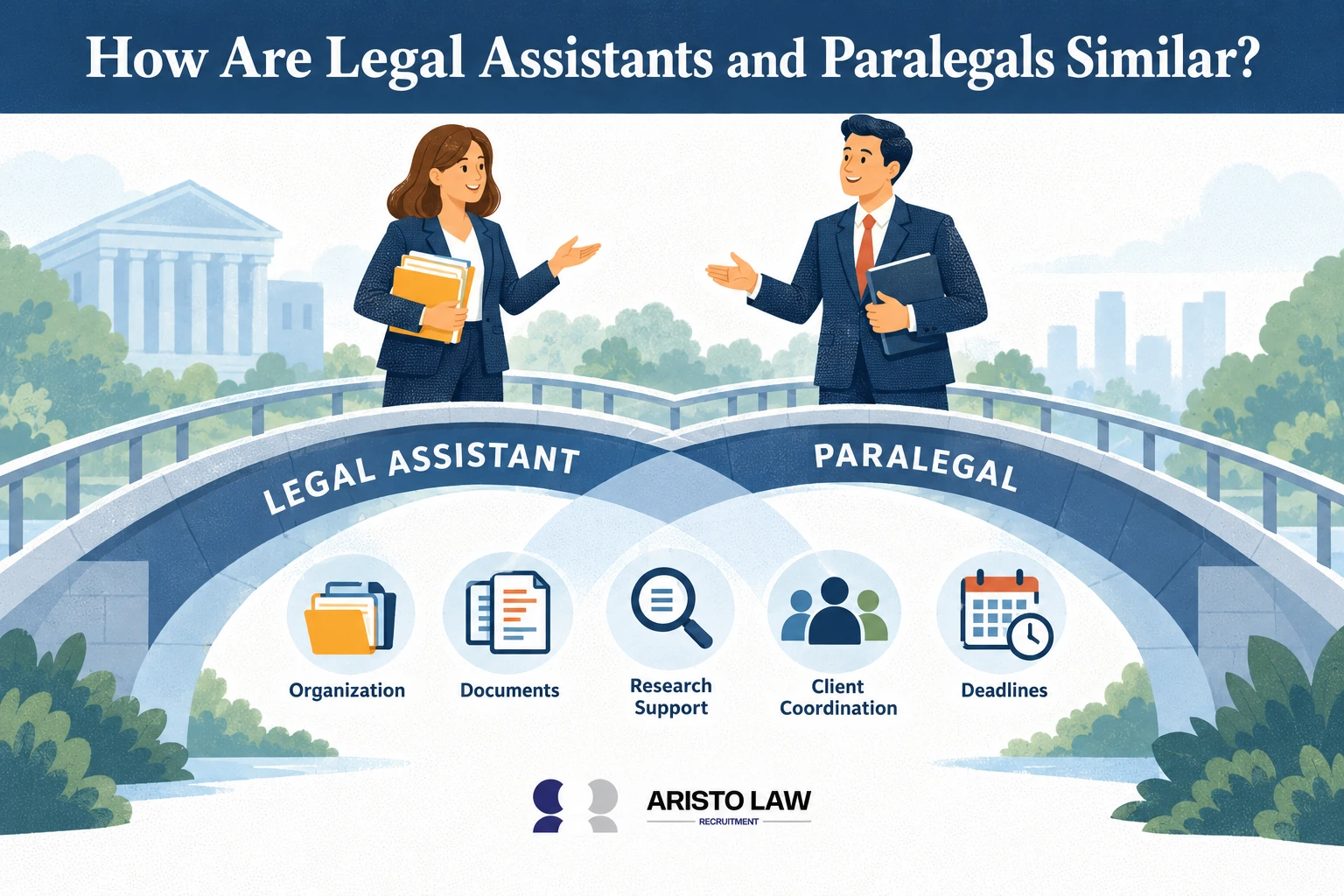
Listed
below are 6 similarities between legal assistants and paralegals.
Both legal assistants and paralegals:
-
Work under attorney supervision
-
Support attorneys and legal teams
-
Manage legal documents and case files
-
Use legal technology and case-management systems
-
Help improve law firm productivity and workflow efficiency
-
Must maintain confidentiality and professional ethics
-
Cannot independently provide legal advice or represent clients unless
authorized by law
Legal workforce and legal operations studies consistently show that
separating administrative functions from substantive legal support
improves efficiency because attorneys assign work according to skill
level, cost-effectiveness, and workflow requirements. Administrative
responsibilities handled by legal assistants allow paralegals and
attorneys to focus on higher-value legal activities, improving
productivity and resource allocation across the law firm.
According to the American Bar Association, a paralegal
performs specifically delegated substantive legal work for which a
lawyer remains responsible, whereas legal assistant
responsibilities emphasize administrative, organizational, and
procedural support. Some law firms use the terms interchangeably, but in
most legal operations environments, paralegals handle more substantive
legal work while legal assistants focus on legal administration and
attorney support services.
How
do U.S. law firms hire South African virtual legal assistants?
U.S. law firms hire South African virtual legal assistants
through specialized staffing providers, legal outsourcing companies,
recruitment partners, and managed legal-support organizations.
The hiring approach chosen depends on the firm’s budget, desired level
of control, support requirements, growth objectives, and internal
management capacity. Modern remote legal support models provide several
sourcing options, each with distinct advantages and limitations.
Direct hiring involves recruiting a virtual legal assistant as a
dedicated remote team member. Law firms source candidates through job
boards, professional networks, referrals, and remote-work platforms.
This model provides the highest level of control over hiring decisions,
training, workflow design, and performance expectations. Direct hiring
delivers strong long-term integration but requires significant
investment in recruiting, interviewing, onboarding, supervision, payroll
administration, and performance management.
Law firms evaluate South African virtual legal assistant by assessing
legal experience, communication standards, workflow compatibility, and
practice-area support requirements. A structured recruitment process for
South African virtual legal assistant services provides practical
insight into how
to hire a virtual legal assistant and match legal
support capacity to firm operations.
Staffing agencies simplify recruitment by sourcing, screening, and
presenting qualified candidates. These agencies commonly evaluate
legal-administration experience, communication skills, English
proficiency, technology knowledge, organizational ability, and
legal-office support backgrounds before recommending candidates.
Staffing firms reduce hiring time and recruitment workload but will
involve placement fees or higher ongoing staffing costs.
Legal outsourcing companies provide a broader support model. Rather
than simply recruiting candidates, these organizations frequently supply
trained legal support professionals, onboarding assistance, workflow
integration support, quality-control systems, and operational oversight.
This approach allows law firms to access remote legal support quickly
while reducing management burdens. The tradeoff is that firms have less
direct control over staffing processes compared with direct hiring.
Managed-service providers operate similarly but include ongoing
supervision, replacement guarantees, productivity monitoring, training
infrastructure, and administrative management. This model is attractive
for firms seeking scalability and operational consistency without
building internal management systems. Costs are higher than direct
hiring because management services are included.
The recruitment process generally includes application reviews,
resume screening, communication assessments, software proficiency
testing, legal-support skills evaluations, reference checks, and
structured interviews. Many firms also conduct practical assessments
involving client intake, CRM management, scheduling tasks, document
organization, email administration, or workflow coordination to verify
job readiness.
Onboarding workflows include confidentiality agreements, security
training, technology setup, process documentation, software access
configuration, workflow instruction, communication protocols, and
performance expectations. Confidentiality safeguards are particularly
important because virtual legal assistants handle sensitive client
information, internal records, and privileged communications. Law firms
commonly implement secure communication systems, access controls,
data-protection policies, and attorney-supervision procedures to
maintain compliance and client confidentiality.
Performance management generally focuses on responsiveness,
communication quality, task accuracy, productivity, workflow adherence,
client-service standards, and operational efficiency. Regular reviews,
documented procedures, key performance indicators, and ongoing training
help maintain consistent service quality.
Each hiring model offers different benefits. Direct hiring provides
maximum control, staffing agencies accelerate recruitment, outsourcing
firms reduce operational burdens, and managed-service providers offer
scalability and structured support. Law firms select the approach that
best aligns with their legal staffing strategy, management resources,
growth plans, and remote legal support requirements.
What
should law firms look for when hiring a South African virtual legal
assistant?
Factors law firms should evaluate when hiring a South African
virtual legal assistant include legal-support experience,
responsiveness, and workflow compatibility.
Listed below are 15 factors law firms should evaluate when hiring a
South African virtual legal assistant.
-
Legal-Support Experience: Evaluate prior experience
supporting attorneys, law firms, legal departments, compliance teams, or
professional-service organizations. Review responsibilities involving
client intake, scheduling, document management, CRM administration,
billing support, case-management assistance, and legal office support.
Interview questions focus on previous legal workflows, administrative
responsibilities, and experience working under attorney supervision. -
Communication Skills: Assess written and verbal
English proficiency, professionalism, listening ability, and
client-service communication. Virtual legal assistants frequently
interact with clients, attorneys, vendors, and support staff. Practical
assessments include email-writing exercises, intake simulations, and
communication role-play scenarios. -
Technology Proficiency: Evaluate familiarity with
legal software, case-management systems, CRM platforms,
document-management tools, scheduling applications, VoIP systems,
Microsoft Office, Google Workspace, and cloud-based collaboration
platforms. Practical testing includes CRM updates, calendar
coordination, document organization, and workflow-management tasks. -
Confidentiality Standards: Assess understanding of
confidentiality obligations, secure information handling, access
controls, document security, and professional ethics. Candidates should
demonstrate awareness of data-protection procedures and sensitivity to
client information. -
Responsiveness: Evaluate reliability, communication
turnaround times, deadline management, availability during designated
working hours, and ability to handle urgent requests. Response-time
expectations are particularly important in client-intake and
administrative-support roles. -
Workflow Compatibility: Review the candidate’s
ability to follow documented procedures, operate within established
systems, adapt to law-firm workflows, and maintain process consistency.
Strong workflow compatibility reduces onboarding challenges and improves
operational efficiency. -
Legal Software Familiarity: Candidates with
experience using legal practice-management platforms, CRM systems,
intake software, billing applications, and document-management tools
integrate more quickly into law-firm operations. -
Client-Service Capabilities: Assess professionalism,
empathy, communication style, and ability to manage client interactions.
Strong client-service skills improve intake performance, client
satisfaction, and communication consistency. -
Organizational Skills: Evaluate file management,
recordkeeping, deadline tracking, scheduling accuracy, information
management, and attention to detail. Organization directly affects
productivity and workflow quality. -
Problem-Solving Ability: Virtual legal assistants
frequently encounter scheduling conflicts, missing information, workflow
disruptions, and administrative challenges. Interview questions should
explore how candidates identify issues and implement solutions within
established procedures. -
Remote-Work Discipline: Assess self-management,
accountability, time management, independent work habits, and ability to
maintain productivity without direct in-office supervision. Previous
remote-work experience is a positive indicator. -
Process Management Experience: Candidates should
demonstrate experience maintaining workflows, tracking assignments,
managing administrative processes, coordinating deadlines, and
supporting operational efficiency. -
Quality-Control Standards: Evaluate accuracy,
consistency, proofreading ability, documentation practices, and
attention to procedural compliance. Administrative errors create
workflow disruptions and client-service problems. -
Adaptability and Learning Capacity: Law firms
frequently use unique procedures and technology stacks. Candidates
should demonstrate the ability to learn new systems, follow training
instructions, and adapt to changing operational requirements. -
Time-Zone and Availability Alignment: Confirm that
the candidate supports required U.S. business hours, overlapping
schedules, or extended coverage models necessary for the firm’s
operational needs.
Evaluating these criteria helps law firms identify virtual legal
assistants who provide reliable legal office support, integrate smoothly
into existing workflows, maintain professional standards, and contribute
to long-term operational efficiency.
What
legal software and systems do virtual legal assistants commonly
use?
Software and systems virtual legal assistants commonly use
include case-management platforms, billing software, and communication
platforms.
Listed below are 13 software and systems that virtual legal
assistants commonly use.
-
Case-Management Platforms: Case-management systems
centralize matter information, deadlines, tasks, notes, and document
records. Virtual legal assistants use these platforms to improve
workflow coordination, maintain case organization, monitor progress, and
reduce administrative delays. Better case visibility supports faster
turnaround times and stronger operational control. -
CRM Systems: CRM platforms help manage leads,
consultations, client communications, intake workflows, and follow-up
activities. Virtual legal assistants use CRM systems to maintain
accurate records, improve lead management, increase responsiveness, and
support client-acquisition processes. Strong CRM usage results in higher
consultation conversion rates and more organized client
relationships. -
Document-Management Tools: Document-management
systems store, organize, track, and retrieve legal documents
efficiently. Virtual legal assistants use these tools to maintain file
consistency, improve accessibility, reduce document-search time, and
support compliance requirements. Organized document systems help legal
teams work more efficiently and reduce workflow interruptions. -
Scheduling Applications: Scheduling tools support
appointment booking, consultation coordination, calendar management,
reminder delivery, and meeting organization. Virtual legal assistants
use these systems to reduce scheduling conflicts, improve consultation
attendance, and streamline attorney availability management. -
Billing Software: Billing platforms support invoice
preparation, time tracking, payment monitoring, expense management, and
financial reporting. Virtual legal assistants use billing systems to
improve billing accuracy, accelerate payment workflows, and support
stronger financial administration. -
Communication Platforms: Communication systems
facilitate collaboration between attorneys, staff, clients, and external
stakeholders. Virtual legal assistants use these tools for messaging,
video meetings, call management, file sharing, and workflow
coordination. Effective communication technology improves responsiveness
and client-service quality. -
Client Intake Platforms: Intake systems help collect
prospect information, manage consultation requests, organize intake
records, and streamline onboarding workflows. Virtual legal assistants
use these platforms to improve lead capture, reduce intake bottlenecks,
and increase operational consistency. -
Document Automation Software: Document-automation
tools help create standardized documents, reduce repetitive
administrative work, and improve document preparation efficiency. These
systems support faster workflow execution and greater consistency across
legal operations. -
Electronic Signature Platforms: E-signature systems
simplify document execution, reduce processing delays, and improve
client convenience. Virtual legal assistants use these tools to
coordinate signatures, monitor completion status, and maintain
executed-document records. -
Task and Workflow Management Systems:
Workflow-management platforms track assignments, deadlines, project
progress, and operational activities. Virtual legal assistants use these
systems to improve accountability, reduce missed tasks, and maintain
workflow continuity. -
Cloud Storage Platforms: Cloud-based systems provide
secure access to documents, records, and shared resources. Virtual legal
assistants use cloud storage to support remote legal support operations,
improve collaboration, and maintain centralized information access. -
Time Tracking and Productivity Tools: Productivity
systems help monitor work output, task completion, resource utilization,
and operational performance. These tools support reporting, workload
management, and process optimization. -
Reporting and Analytics Platforms: Reporting tools
help law firms evaluate intake performance, workflow efficiency,
client-acquisition activity, billing trends, and operational
productivity. Virtual legal assistants assist with data collection,
report generation, and performance monitoring.
Technology adoption improves legal operations through faster
turnaround times, stronger workflow coordination, better document
organization, enhanced client communication, improved reporting
visibility, and greater operational efficiency. For this reason,
technology adaptability is a major hiring consideration. Law firms
frequently prioritize virtual legal assistants who quickly learn new
systems, navigate multiple software platforms, follow documented
technology workflows, and integrate seamlessly into existing legal
operations and remote legal support environments.
Are
South African virtual legal assistants suitable for solo attorneys and
small law firms?
South African virtual legal assistants are particularly
suitable for solo attorneys and small law firms seeking professional
legal support without the cost of full-time in-house staffing.
Many smaller legal practices face ongoing challenges related to limited
budgets, fluctuating workloads, increasing client-service expectations,
and administrative responsibilities that consume valuable attorney time.
Hiring a full-time in-house legal assistant requires significant
investment in salary, benefits, payroll taxes, office space, equipment,
training, and ongoing overhead, which are not practical for firms with
variable support needs.

South African virtual legal assistants help address these challenges
by providing flexible remote legal support that scales according to
workload demands. Attorneys obtain assistance with client intake,
appointment scheduling, CRM management, document organization, billing
support, email administration, calendar coordination, client
communication, and case-management administration without committing to
traditional staffing structures. This allows solo practitioners and
small firms to maintain professional operations while controlling
costs.
Operational consistency is another major advantage. Administrative
bottlenecks frequently occur when attorneys must manage legal work and
business operations simultaneously. Virtual legal assistants help
maintain organized workflows, improve responsiveness, support client
communications, and ensure administrative tasks are completed
consistently. This structure reduces interruptions and allows attorneys
to devote more time to legal analysis, client counseling, negotiations,
business development, and litigation activities.
Scalability is particularly valuable for growing firms. Virtual legal
assistants enable practices to increase support capacity during
litigation surges, marketing campaigns, seasonal workload increases, or
expansion initiatives without hiring multiple in-house employees. Firms
add part-time, full-time, or dedicated support as operational needs
evolve.
Practice areas with high administrative volume benefit most from
remote legal-support models. Personal injury, family law, immigration,
estate planning, criminal defense, bankruptcy, workers’ compensation,
employment law, and civil litigation frequently involve substantial
intake coordination, document management, scheduling, client
communication, records administration, and workflow tracking. Delegating
these functions helps improve efficiency while maintaining strong client
service.
South African virtual legal assistants also offer strong English
proficiency, professional communication skills, familiarity with
international business environments, and the ability to align schedules
with U.S. business hours. Combined with staffing savings that frequently
range from approximately 40–70% compared with comparable in-house
support positions, these advantages make remote legal staffing an
attractive solution for solo attorneys and small law firms seeking
operational efficiency, staffing flexibility, and sustainable growth
without significant overhead expansion.
Where
can American law firms hire South African virtual legal assistants?
American law firms hire South African virtual legal
assistants through virtual staffing companies, and specialized
legal-support organizations, legal outsourcing providers such as Aristo
Law. These sourcing channels provide different levels of
recruitment assistance, training, supervision, and operational support,
allowing firms to select a staffing model that aligns with their budget,
growth objectives, and workflow requirements.
Legal outsourcing providers specialize in supplying remote legal
support professionals who assist with client intake, scheduling,
document management, CRM administration, billing support,
case-management coordination, and legal-office operations. Many
providers maintain established recruitment pipelines and legal-support
training programs, helping firms access qualified talent more quickly
than traditional hiring methods.
Virtual staffing companies focus on recruiting and placing dedicated
remote professionals who work directly with law firms. These
organizations handle candidate sourcing, screening, interviewing,
background verification, and onboarding support. This approach reduces
recruitment burdens while allowing firms to maintain direct day-to-day
management of the virtual legal assistant.
Managed legal-support organizations provide a broader service model
that includes recruiting, onboarding, training support, quality-control
systems, staffing replacement options, and operational oversight. These
providers frequently accelerate deployment timelines because candidates
are pre-screened and prepared to integrate into law-firm workflows. Many
firms prefer managed-service models because they reduce administrative
burdens associated with hiring, training, and performance
management.
When evaluating outsourcing partners, law firms commonly assess
legal-industry experience, staffing quality, communication skills,
English proficiency, confidentiality standards, technology proficiency,
onboarding support, scalability, quality-control processes, replacement
guarantees, and workflow integration capabilities. Firms also evaluate a
provider’s ability to support specific practice areas, maintain
operational consistency, and align with existing legal technology
systems.
Managed legal-support providers reduce recruitment challenges by
eliminating the need for lengthy sourcing campaigns, multiple interview
rounds, extensive screening processes, and independent training
development. This allows firms to obtain qualified support more quickly
and focus internal resources on client service and legal work.
Aristo Law helps law firms solve legal outsourcing challenges by
connecting attorneys with trained virtual legal assistants and legal
support professionals suited to specific practice-area workflows and
operational requirements. Aristo Law supports law firms through
outsourced legal staffing solutions that include client intake
coordination, appointment scheduling, CRM management, legal
administration, workflow support, client communication, and operational
assistance. Rather than offering a one-size-fits-all staffing model,
Aristo Law helps match legal support professionals to the unique needs
of solo attorneys, small firms, growing practices, and multi-state law
firms.
Through legal-industry-focused staffing, onboarding support, workflow
integration, and scalable remote legal support solutions, Aristo Law
helps firms improve efficiency, expand support capacity, reduce
administrative burdens, and build cost-effective legal operations
without the complexity of traditional hiring processes.
Build a legal support team that moves work forward.
Tell us what is slowing your practice down. We will help map the role, workflow, and support structure that fits.